

Description
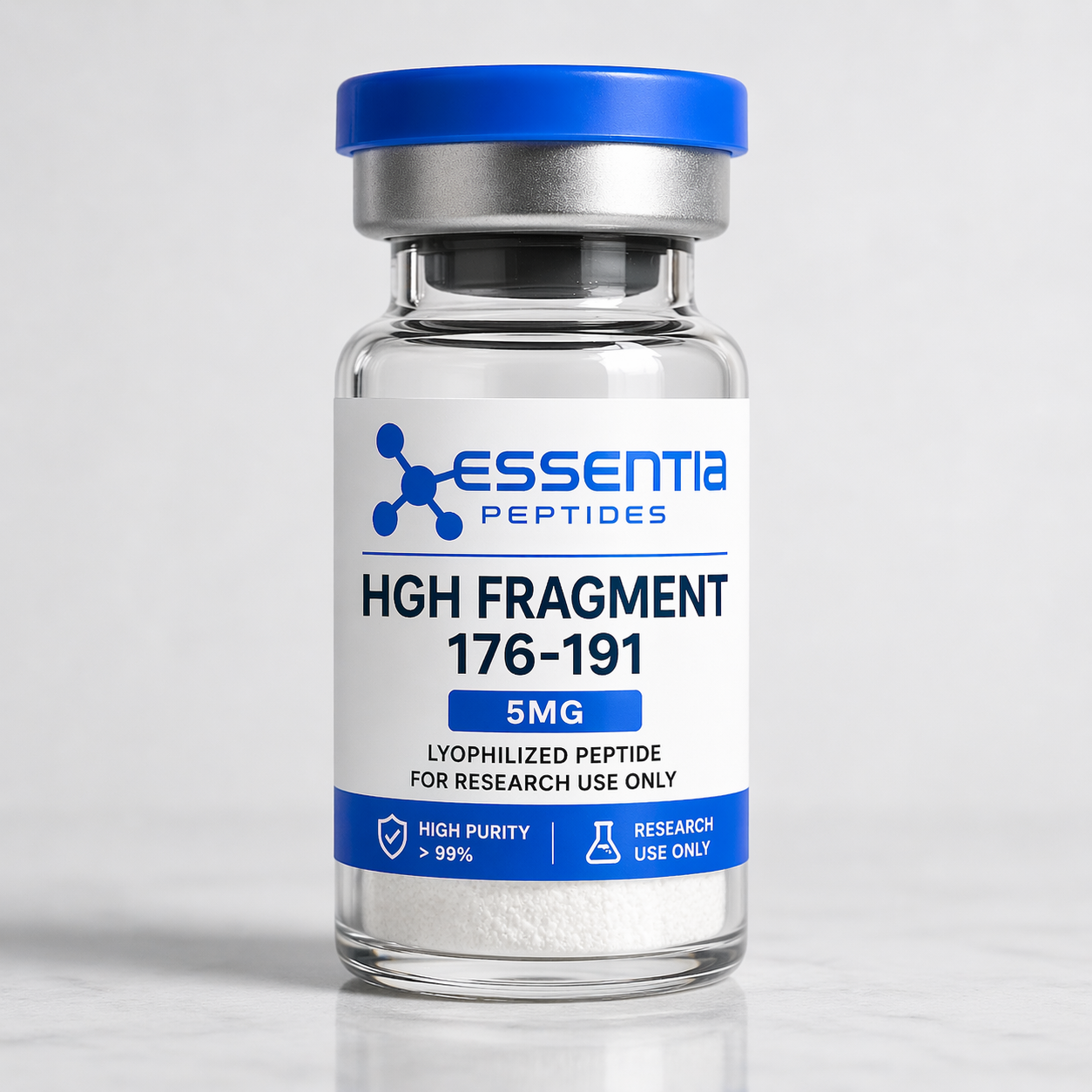
Hgh fragment 176-191
HGH Fragment 176-191, commonly referred to as HGH Frag, is a synthetic peptide consisting of the last 16 amino acids of the full Growth Hormone (GH) molecule. Unlike standard Growth Hormone–based peptides, HGH Frag 176-191 does not act broadly on GH receptors; instead, it targets lipolytic pathways specifically, making it one of the most studied peptides in fat metabolism research.
This peptide is engineered to reproduce the portion of HGH responsible for fat-burning and metabolic regulation. Scientific studies demonstrate that HGH Fragment 176-191 may influence adipose tissue behavior without the typical effects associated with full-length Growth Hormone, making it highly valuable for targeted metabolic experiments.
Scientific Background
HGH contains multiple regions responsible for regulating various physiological processes. Research shows that amino acids 176–191 are particularly active in regulating fat breakdown. HGH Fragment 176-191 is a modified form of this region, designed to improve:
-
stability
-
receptor binding
-
metabolic specificity
-
resistance to enzymatic breakdown
Due to its targeted effects, scientists prefer HGH Frag for isolating fat metabolism pathways without interference from GH-related growth or glucose mechanisms.
Key Research Applications
1. Fat Oxidation & Lipolysis
HGH Fragment 176-191 is most widely used to study:
-
lipolytic activity in adipose cells
-
breakdown of stored fat
-
fatty acid mobilization
-
metabolic rate acceleration
Researchers use the peptide in controlled settings to observe how isolated GH fragments may regulate body fat.
2. Energy & Metabolic Regulation
Because HGH Fragment 176-191 acts primarily on adipose receptors, it is a powerful tool for:
-
studying glucose metabolism
-
evaluating mitochondrial efficiency
-
exploring energy balance in metabolic tissues
-
analyzing hormonal fat regulation
Its specificity allows scientists to measure metabolic effects without the broad systemic responses of full Growth Hormone.
3. Cell Signaling Pathway Analysis
Scientists use HGH Frag to understand GH-fragment-specific pathways, including:
-
beta-oxidation
-
AMPK activation
-
enhanced fat utilization
-
anti-lipogenic signals
These pathways help investigators map out biological processes relevant to obesity, insulin regulation, and energy expenditure.
4. Peptide Stability & Bioactivity Research
The structure of HGH Fragment 176-191 includes strategic amino acid substitutions to improve:
-
peptide stability
-
biological half-life
-
receptor affinity
Because of this, the peptide is widely used in pharmacological and biochemical research exploring peptide engineering and optimization.
Lab Specifications
-
Form: Lyophilized powder
-
Purity: ≥99% (HPLC Verified)
-
Molecular Sequence: Tyr-Leu-Arg-Ile-Val-Gln-Cys-Ala-Phe-Lys-Lys-Pro-Val
-
Storage: –20°C recommended
-
Shelf Life: Long-term stability under proper conditions
-
Use: Scientific research only, not for human consumption
Every vial is produced in certified laboratory environments with COA documentation available upon request.
Research-Use Only Notice
HGH Fragment 176-191 provided by EssentiaPeptides is strictly intended for laboratory research. It is not approved for use in humans and must be handled under professional scientific conditions.

Ethan –
Results came quicker than expected. The package was well handled and support was responsive.
Zoe –
Great experience overall. Product quality is consistent and delivery was smooth.
Liam –
Satisfied with performance and packaging. I will continue ordering from here.
Mia –
Product works as described. Shipping was fast and communication was easy.
Noah –
Results improved steadily. Delivery arrived in good condition and on time.
Emma –
Good consistency and customer support followed up professionally.
Lucas –
The effect is fair and reliable. Shipping was acceptable.
Ava –
Positive outcome and good service experience. Would recommend.
imgedit ai –
You actually make it seem so easy with your presentation but I find this matter to
be really something that I think I would never understand.
It seems too complex and very broad for me.
I am looking forward for your next post, I’ll try to
get the hang of it!
socolive105.ac lừa đảo công an việt nam cảnh báo truy quét cấm gấp –
Hello there, I found your web site by the use of Google even as searching for a related subject, your site got here up, it seems
to be good. I have bookmarked it in my google bookmarks.
Hi there, simply became aware of your blog thru Google, and found that
it is truly informative. I’m going to be careful for brussels.
I’ll appreciate when you continue this in future. A lot of folks
might be benefited from your writing. Cheers!
Юрист по миграции –
I do not even know how I finished up right here, but I believed
this put up was once good. I do not know who
you might be however certainly you are going
to a famous blogger for those who are not already. Cheers!
scar revision –
Good post. I learn something new and challenging on sites I stumbleupon on a daily basis.
It will always be interesting to read articles from other writers and use a little something from their sites.
Gelatin Trick –
Hello just wanted to give you a quick heads up.
The text in your post seem to be running off the screen in Safari.
I’m not sure if this is a formatting issue or something to do with web browser compatibility but I figured I’d post to let you know.
The design look great though! Hope you get the issue solved soon. Many thanks
beauty health wellness –
I know this web site gives quality dependent articles and additional stuff,
is there any other site which presents these information in quality?
olxtoto –
Hello! I could have sworn I’ve been to this website before but after browsing through many of the posts I realized it’s new
to me. Anyways, I’m definitely happy I stumbled upon it and I’ll be bookmarking it and checking back often!